
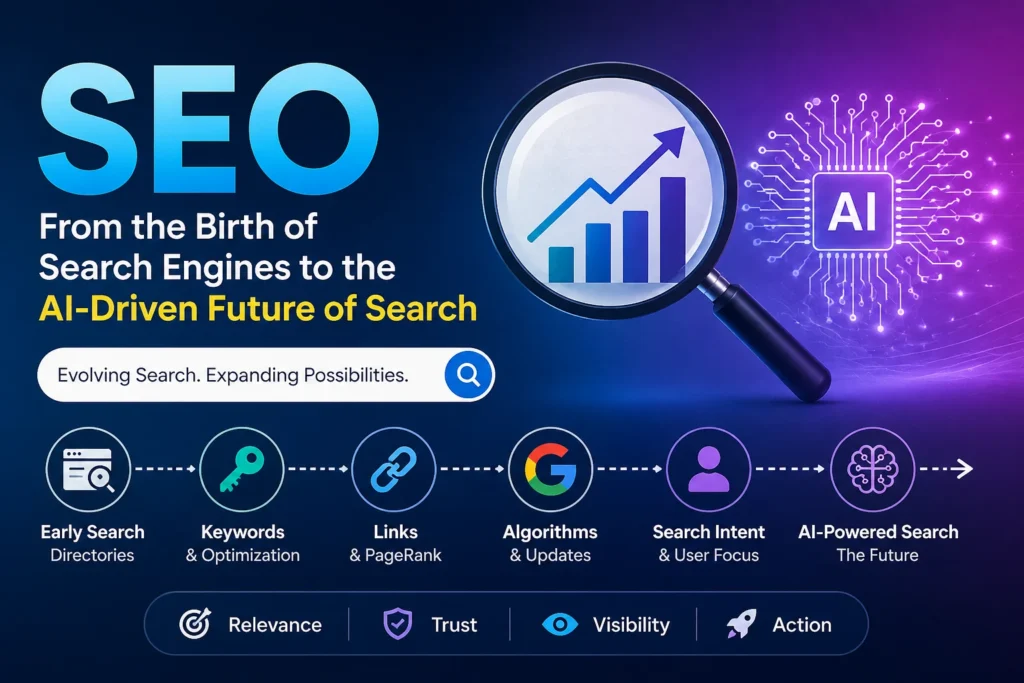
SEO (Search Engine Optimization) has changed more dramatically than almost any other digital marketing discipline.
What began as a relatively simple effort to help search engines understand webpages has evolved into a much broader discipline involving content quality, search intent, technical architecture, user experience, authority, brand visibility, data, artificial intelligence, and now generative search.
In the early days, SEO could revolve heavily around keywords optimization and links. Today, simply placing a keyword on a page is nowhere near enough.
Search engines have become better at understanding language, context, relationships between concepts, user intent, and the overall usefulness of information. At the same time, AI-powered search experiences are changing how people discover and consume information.
That raises a bigger question:
Where did SEO actually come from, where is it today, and what will SEO become in the future?
To understand the future of search, we first need to understand its evolution.
What Is SEO?
Search Engine Optimization is the practice of improving a website and its content so that search engines can discover, understand, evaluate, and potentially surface it for relevant searches.
But that technical definition does not capture the full purpose of SEO.
At a business level, SEO is about connecting the right person with the right information, product, service, or solution at the right moment.
That means modern SEO is not simply:
Keyword → Ranking → Traffic
A more realistic model is:
User Need → Discovery → Relevance → Trust → Visibility → Experience → Action
This distinction is important because search itself has never stopped evolving.
1. Before SEO: The Internet Needed a Map
The earliest web did not have the enormous number of websites and pages we have today.
As the World Wide Web expanded, users needed ways to discover and navigate websites. Early search tools and directories helped organize this growing collection of information.
The fundamental problem was simple:
How can a person find something useful when they don’t know where it exists?
Search engines gradually became better at solving that problem.
Instead of relying only on manually organized directories, search systems began crawling webpages, storing information in indexes, and returning results based on relevance.
This created a new relationship between websites and search engines.
If a search engine determined which webpages users saw first, website owners naturally wanted to understand what influenced those decisions.
That was the beginning of SEO as a recognizable marketing discipline.
2. The First Era of SEO: Keywords and Manipulation
Early search optimization was comparatively straightforward.
Search engines relied heavily on textual information. Website owners learned that keywords appearing in titles, headings, URLs, metadata, and page content could help search engines understand what a page was about.
But an economic opportunity almost always creates incentives for manipulation.
Some website owners began repeating keywords excessively. Others experimented with hidden text, doorway pages, automatically generated pages, and other techniques designed primarily to capture search traffic.
The underlying problem was becoming obvious:
If people can discover patterns in a ranking system, some will try to exploit those patterns.
Search engines therefore had to become more sophisticated.
And SEO had to evolve with them.
3. Google and the PageRank Revolution
Google’s emergence fundamentally changed the search landscape.
One of the ideas that helped distinguish Google was PageRank, Google’s approach to evaluating the importance of webpages partly through relationships represented by links.
The underlying concept was powerful.
A link could act as a signal that one page or website was connected to or recommending another.
This moved search beyond simply asking:
“Does this page contain the words I searched for?”
It introduced another question:
“How important or authoritative does this page appear to be within the wider web?”
PageRank became an important part of Google’s ranking systems, although Google’s search systems have evolved enormously since the company’s early years.
The result was a major transformation in SEO.
Backlinks became valuable.
Authority became important.
And an entire SEO industry developed around earning, building, evaluating, and sometimes manipulating links.
That produced another cycle:
Search engines improve → marketers identify patterns → some marketers exploit patterns → search engines fight manipulation → SEO evolves again.
4. The Algorithm Became the Battlefield
Google’s search systems continued to develop.
Several historical systems became particularly important in the evolution of SEO.
Panda was designed to help surface higher-quality and original content.
Penguin focused on combating link spam.
Hummingbird, introduced in 2013, represented a major improvement to Google’s overall ranking systems and its ability to better understand queries.
Later, Google’s systems increasingly incorporated machine learning and broader contextual understanding.
Google’s current documentation records Panda and Penguin as historical systems that were eventually incorporated into Google’s core ranking systems. It also states that the Helpful Content System, launched in 2022, became part of Google’s core ranking systems in March 2024.
The larger story is more important than the names of individual updates.
Search was moving away from simple keyword matching and toward:
Relevance + Context + Quality + Intent + Usefulness
That shift changed the way serious SEO professionals approached content.
5. The Rise of Search Intent
One of the most important lessons in modern SEO is that keywords and intent are not the same thing.
Consider the search:
“running shoes”
What does the searcher actually want?
They could be:
- Researching different types of running shoes
- Looking for the best running shoes
- Comparing brands
- Ready to purchase
- Looking for shoes for flat feet
- Searching for discounts
- Looking for reviews
- Trying to understand which shoes fit a particular running style
The keyword remains the same.
The intent changes.
This is why modern SEO asks a much more useful question:
What is the user actually trying to accomplish?
A strong SEO page does not merely contain a keyword.
It solves the problem behind the keyword.
6. Content SEO: From Keyword Density to Information Quality
There was a time when SEO content was frequently approached like a formula:
Choose keyword → repeat keyword → reach a word count → publish
That approach does not represent modern SEO.
Google’s current guidance explicitly emphasizes helpful, reliable, people-first content. It also says there is no preferred word count that creators should target simply because they believe it is a ranking requirement.
The more useful question is:
Does this page give the visitor something genuinely valuable?
High-quality content can include:
- Original information
- Clear explanations
- Strong topical relevance
- Accurate facts
- First-hand experience
- Useful examples
- Meaningful analysis
- Logical organization
- Appropriate depth
- Clear authorship
- Supporting evidence
- Helpful internal links
- Practical next steps
Google’s people-first guidance specifically encourages creators to consider whether content demonstrates first-hand expertise and depth of knowledge, whether readers will feel satisfied after consuming it, and whether the content provides original value beyond what is already available.
This represents one of the biggest differences between old SEO and modern SEO Services.
The goal is no longer to write for an algorithm first.
The goal is to create something useful for people while making it easy for search engines to understand.