
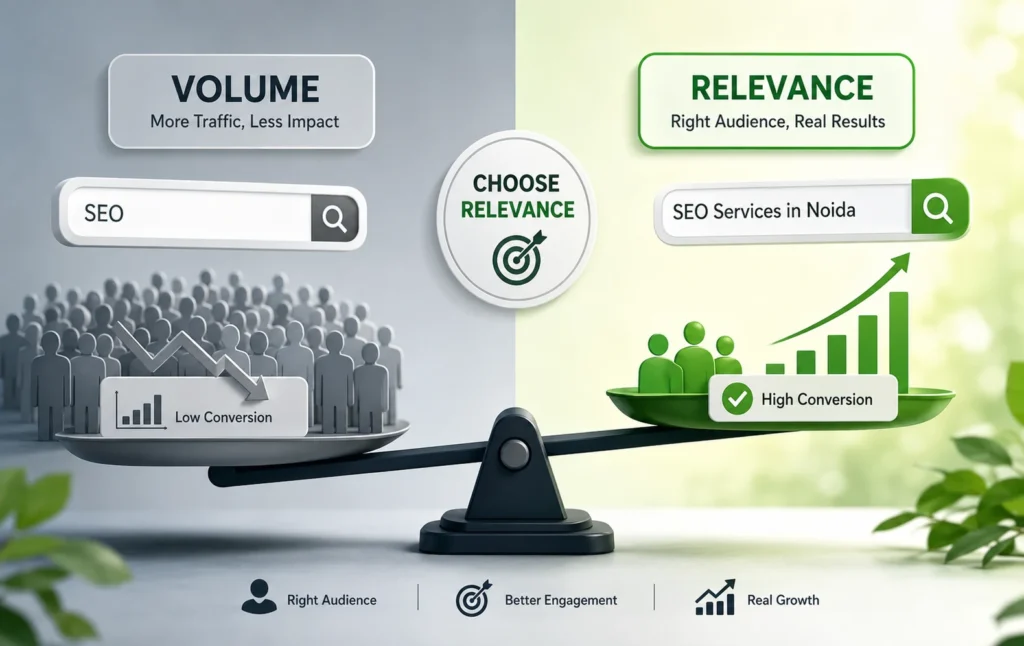
For many years, SEO professionals and website owners chased one metric above all else: keyword volume. The logic seemed simple—if a keyword receives thousands of searches every month, ranking for it should generate more traffic and more business. However, Google’s search algorithms have evolved dramatically. In 2026, successful SEO is no longer about targeting the biggest keywords; it is about targeting the most relevant ones.
Search engines have become significantly better at understanding user intent, content quality, context, and topical expertise. As a result, websites that focus solely on high-volume keywords often struggle to convert visitors into customers, while businesses that prioritize keyword relevance frequently achieve higher engagement, better rankings, and stronger conversion rates.
The modern SEO landscape rewards content that genuinely helps users solve problems. This is why keyword relevance has become far more important than keyword volume.
Understanding Keyword Volume
Keyword volume refers to the estimated number of times a specific search query is entered into search engines within a given period, usually monthly. Before targeting a keyword, use our Keywords Optimization Tool to identify search intent and content opportunities.
For example:
- “Digital Marketing” may have very high search volume.
- “Digital Marketing Services for Real Estate in Noida” may get lower volume.
At first glance, the high-volume keyword appears more attractive. However, volume alone tells only part of the story. It does not explain why users are searching, what information they need, or whether they are likely to take action after landing on your website.
A keyword can generate thousands of visitors while delivering very few leads, sales, or meaningful interactions.
What Is Keyword Relevance?
Keyword relevance refers to how closely a search query aligns with:
|
|
|
|
|
Relevant keywords connect your content directly to what users are actually looking for on the internet.
For instance, if someone searches for:
“Best SEO Service for local businesses in Noida”
they are demonstrating a clear need and specific intent. A company offering local SEO services can create highly targeted content that directly addresses this searcher’s requirements.
Although the search volume may be lower than broader keywords such as “SEO,” the relevance is significantly higher.
Google’s Evolution Toward Intent-Based Search
Google’s ranking systems have become increasingly focused on understanding the meaning behind searches rather than matching exact words.
Modern algorithms evaluate:
- Search intent
- Contextual relevance
- Content depth
- Topic authority
- User satisfaction
- Experience and expertise
- Content usefulness
This means a page that thoroughly answers a user’s question often outperforms a page that simply targets a popular keyword.
Google’s Helpful Content System continues to reward content created for people rather than search engines. Websites that prioritize relevance naturally align with this objective because they focus on solving real user problems.
Why High-Volume Keywords Often Fail
Many website owners assume that more traffic automatically means more success. In reality, traffic without intent rarely produces meaningful business outcomes.
Consider a company selling commercial real estate consulting services.
Targeting:
“Real Estate”
may attract visitors interested in:
- Residential homes
- Property news
- Real estate careers
- Investment education
- Market trends
Most of these visitors may never become customers.
Now consider targeting:
“Commercial Property Investment Consultant in Noida”
The search volume may be smaller, but the visitors are far more likely to require the exact service being offered.
This demonstrates why relevance often generates better results than raw traffic numbers.
Relevance Improves Conversion Rates
One of the biggest advantages of keyword relevance is improved conversion performance.
Imagine two scenarios:
Scenario 1 | Scenario 2 |
Keyword: “Marketing” | Keyword: “Performance Marketing Agency for Educational Institutes” |
Monthly Visitors: 10,000 | Monthly Visitors: 1,000 |
Conversion Rate: 0.2% | Conversion Rate: 5% |
Total Leads: 20 | Total Leads: 50 |
Despite receiving far less traffic, the relevant keyword generates more than twice the number of leads.
Better User Experience Through Relevant Content
When users find exactly what they are searching for, several positive signals occur:
- Longer session duration
- Lower bounce rates
- Higher engagement
- More page views
- Increased trust
- Better conversion rates
Google monitors many of the signals to understand content that satisfies search intent.
When a webpage delivers information that aligns with visitor needs, it creates a seamless user experience. People who receive relevant information right away tend to spend more time on a website, engage more deeply with its offerings, and show a greater likelihood of converting.
This user-first approach aligns perfectly with modern SEO best practices.
The Rise of Long-Tail Keywords
Long-tail keywords have become increasingly valuable because they reflect specific user intent.
Examples include: Benefits of long-tail keywords include:
Best local SEO services for healthcare clinics | Lower competition |
Affordable PPC management for startups | Higher relevance |
Commercial property marketing agency in Noida | Better conversion potential |
SEO strategy for e-commerce businesses | Faster ranking opportunities |
These searches reveal exactly what users want.
In many industries, long-tail keywords drive the majority of qualified traffic.
Topical Authority Depends on Relevance
Google increasingly rewards websites that demonstrate expertise within a specific subject area.
A website that consistently publishes relevant content around a particular topic builds topical authority over time.
For example, a digital marketing agency may publish content about:
- SEO strategies
- Google Ads optimization
- Meta advertising
- Conversion rate optimization
- Local SEO
- Analytics and reporting
This creates a strong thematic relationship between pages and signals expertise to search engines.
Randomly targeting high-volume keywords outside your niche can weaken this authority.
Relevance strengthens topical consistency, which helps improve overall search visibility.
Semantic Search Makes Relevance More Important
Modern search engines no longer rely on exact keyword matching.
Google understands: | Example, a page about local SEO may rank for: |
Synonyms | Local search optimization |
Related concepts | Google Business Profile optimization |
User context | Local business rankings |
Natural language patterns | Local search visibility |
without repeating the same keyword excessively.
While avoiding keyword stuffing is important, content creators can still use a Keyword Density Checker Tool to monitor keyword usage and maintain a natural optimization balance..
Relevance Supports Google’s E-E-A-T Principles
Google evaluates content using principles often referred to as Experience, Expertise, Authoritativeness, and Trustworthiness (E-E-A-T).
Relevant content naturally supports these factors because it focuses on areas where the website has genuine knowledge and experience.
When content demonstrates:
- Practical expertise
- Real-world insights
- Industry knowledge
- Accurate information
- Helpful guidance
When a website becomes more trustworthy in the eyes of both users and search engines. Keyword relevance helps ensure content remains aligned with these quality expectations.
Balancing Volume and Relevance
This does not mean keyword volume should be ignored entirely.
Volume remains useful for: |
Identifying opportunities |
Estimating traffic potential |
Understanding market demand |
However, volume should never be the primary decision-making factor.
The ideal keyword strategy balances: |
Relevance |
Intent |
Competition |
Conversion potential |
Search demand |
When forced to choose between a highly relevant keyword and a high-volume but loosely related keyword, relevance is usually the smarter investment.
How to Choose Relevant Keywords
To identify relevant keywords, start by understanding your audience.
Ask questions such as: | Next, analyze: |
What problems are users trying to solve? | Search intent |
What information are they seeking? | Audience needs |
What services or products do they need? | Business objectives |
What stage of the buying journey are they in? | Competitor content |
After selecting target keywords, use a Keyword Density Checker Tool to ensure important terms appear naturally throughout the content without over-optimization. After publishing content, use our URL Checker Tool to verify indexing and accessibility.
Conclusion
The future of SEO belongs to relevance, not volume. Google’s algorithms continue to prioritize content that satisfies user intent, demonstrates expertise, and provides meaningful value. While high-volume keywords may look attractive on paper, they often fail to deliver qualified traffic or business results.
Relevant keywords attract the right audience, improve user experience, strengthen topical authority, support E-E-A-T principles, and generate higher conversion rates. The real value of organic search lies in attracting highly targeted visitors rather than simply increasing overall website traffic numbers.
Businesses that focus on keyword relevance create content that genuinely helps users, aligns with Google’s quality standards, and drives sustainable organic growth. As SEO continues to evolve in 2026 and beyond, relevance will remain one of the most important factors in achieving long-term search visibility and business success.