
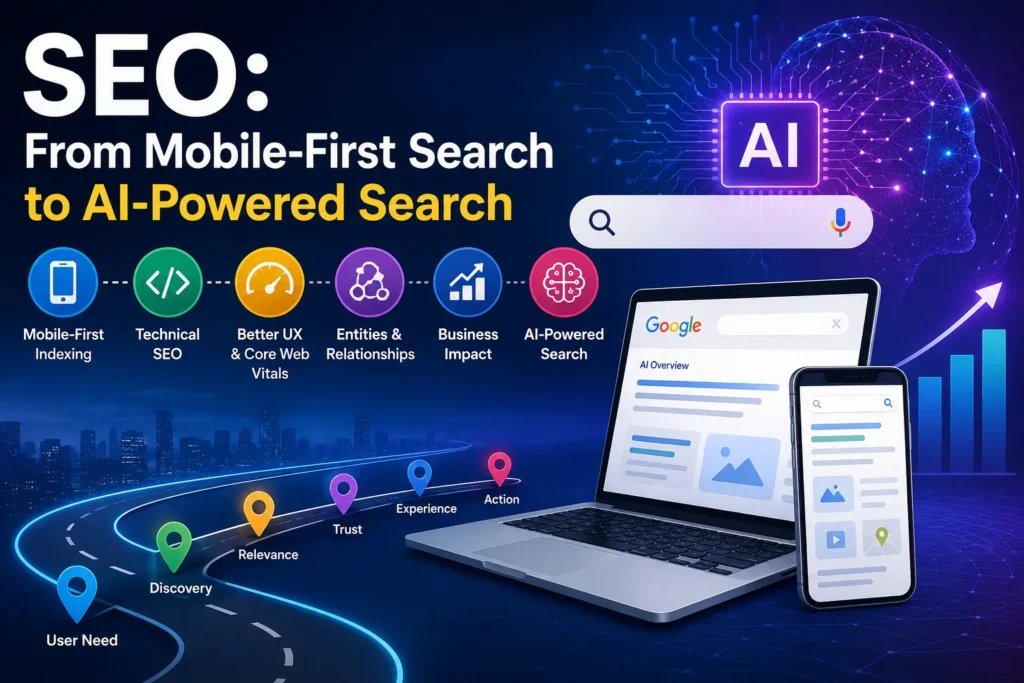
Mobile Changed SEO Forever
Search behavior changed dramatically when smartphones became a primary way people accessed the internet.
People began searching while travelling, shopping, comparing products, watching videos, reading reviews, checking locations, and making decisions in real time.
Google responded with mobile-first indexing.
Google officially completed its transition to mobile-first indexing in October 2023. Today, Google primarily uses the mobile version of a site’s content for indexing and ranking.
This created an important principle:
Mobile SEO is not a secondary version of SEO. It is fundamental to modern SEO.
A website can have excellent content and still provide a poor experience if:
- Pages are slow
- Layout shifts unexpectedly
- Buttons are difficult to use
- Navigation is confusing
- Important content is missing on mobile
- Text is difficult to read
- Interactions feel frustrating
This is where SEO began intersecting more deeply with UX and web development.
Technical SEO Became a Core Discipline
As websites became more sophisticated, SEO stopped being something that could be managed only by changing article text.
Modern websites can contain:
- JavaScript applications
- Dynamic URLs
- Filters
- APIs
- Product variants
- International versions
- Personalization
- Client-side rendering
- Large databases
- Thousands or millions of URLs
Search engines therefore need to perform a sequence of tasks:
Discover → Crawl → Render → Understand → Index → Retrieve → Rank
If something breaks in that process, even excellent content may struggle to receive visibility.
Technical SEO therefore covers areas such as:
- Crawlability
- Indexability
- Robots.txt
- XML sitemaps
- Canonical URLs
- Redirects
- HTTP status codes
- JavaScript rendering
- Structured data
- Site architecture
- Internal linking
- International SEO
- Mobile rendering
- Performance
Google’s Search Essentials also emphasizes making content accessible to Google and creating helpful, reliable, people-first content.
Technical SEO is therefore not about making a website “look technical.”
It is about removing obstacles between valuable information and the systems that need to discover and understand it.
Core Web Vitals and the User Experience
Search visibility cannot be considered completely separately from user experience.
Google’s Core Web Vitals currently focus on three user-experience measurements:
- LCP (Largest Contentful Paint) — loading performance
- INP (Interaction to Next Paint) — responsiveness
- CLS (Cumulative Layout Shift) — visual stability
Google recommends aiming for an LCP of 2.5 seconds or less, INP below 200 milliseconds, and CLS below 0.1 for a good user experience.
These metrics do not mean that SEO can be reduced to a speed score.
A fast website with useless content is still not a great search result.
But excellent and Plague free content presented through a slow, unstable, frustrating experience can also create a poor user journey.
Modern SEO therefore sits at the intersection of:
Content + Technology + UX
SEO Became an Entity and Relationship Game
Another major evolution has been the movement beyond individual keywords Density toward concepts, entities, and relationships.
Consider:
Apple → iPhone → iOS → Camera → Specifications → Review → Retailer → User Need
A modern search system does not need to treat these simply as isolated words.
It can understand relationships between concepts.
This matters because users increasingly search in natural language.
They may not use the exact keyword appearing on a page.
They may describe a problem differently.
Modern SEO therefore requires more than inserting exact-match phrases.
Businesses need to establish clear relationships between:
Topics + Products + Services + People + Places + Problems + Solutions + Brand
This is why topical authority and clear information architecture have become increasingly important.
SEO Became a Business Function
At some point, SEO stopped being merely a traffic-generation tactic.
For a serious business, organic search can influence:
Visibility → Traffic → Engagement → Leads → Sales → Revenue → Customer Lifetime Value
That changes how SEO should be measured.
Ranking #1 for a keyword with almost no commercial value does not necessarily represent success.
A lower-ranking page that consistently generates qualified leads can be significantly more valuable.
Mature SEO measurement therefore looks beyond rankings and considers:
- Qualified organic traffic
- Organic conversions
- Revenue
- Conversion rate
- Customer acquisition cost
- Assisted conversions
- Brand demand
- Non-brand growth
- Search visibility
- Topic performance
- SERP presence
- Customer lifetime value
The real objective is not:
“Get more organic traffic.”
It is:
“Generate more valuable business outcomes from organic discovery.”
Then Artificial Intelligence Changed the Search Experience
Generative AI introduced another major shift in the search ecosystem.
People can now ask much more complex questions conversationally.
Instead of:
“best CRM software”
a user might ask:
“I run a 20-person B2B sales team with a limited budget. Compare the best CRM options for us, explain the trade-offs, and tell me which one makes the most sense.”
That is not simply a keyword Optimization.
It is a task.
Modern AI-powered search experiences are increasingly designed to understand longer questions, follow-up questions, comparisons, exploration, and multi-step information needs.
Google’s current documentation states that AI Overviews and AI Mode are grounded in Google’s Search systems and can use techniques such as retrieval-augmented generation to retrieve relevant information from the Search index. Google also describes a “query fan-out” approach in which related searches can be performed across subtopics and data sources.
This changes the SEO battlefield.
Is SEO Dead Because of AI?
No.
But low-value SEO is under increasing pressure.
Google’s current guidance says established SEO best practices remain relevant to AI features such as AI Overviews and AI Mode because those experiences are built on Google’s core Search systems.
The question is therefore changing.
Traditional SEO often asks:
“How do I rank this page?”
The emerging search environment also asks:
“Why would an AI-powered search experience retrieve, reference, cite, or recommend this information?”
That is a much larger challenge.
And it creates a new opportunity.
The Future of SEO: Search Everywhere
Search is no longer limited to ten blue links.
People discover information through:
- Google Search
- AI search experiences
- Chatbots
- YouTube
- Social platforms
- Google Maps
- Ecommerce marketplaces
- Voice interfaces
- Visual search
- Browser-based AI experiences
- Specialized search engines
- Community platforms
This does not mean traditional Google SEO disappears.
It means discovery becomes more distributed.
The future SEO professional may therefore need to think less like a traditional ranking specialist and more like a:
Digital Discovery Strategist
The objective becomes:
Make the brand discoverable wherever its audience looks for answers.
Generative AI Will Make Original Information More Valuable
AI has made content production dramatically easier.
That creates a paradox.
If almost everyone can produce a 1,500-word article on the same subject, then another generic article may provide very little competitive advantage.
The scarce resource becomes original information.
Google’s current guidance for generative AI search explicitly emphasizes unique viewpoints, non-commodity content, first-hand experience, helpful information, and original value. It also warns against creating large quantities of pages primarily to manipulate rankings or AI search visibility.
That makes assets such as these increasingly valuable:
- Original research
- Proprietary data
- Expert commentary
- First-hand testing
- Customer insights
- Case studies
- Experiments
- Original statistics
- Unique frameworks
- Real-world examples
- Strong opinions supported by evidence
- Industry-specific experience
The competitive advantage increasingly becomes:
Experience + Evidence + Expertise + Originality
AI Does Not Automatically Make Content Bad
There is an important distinction that publishers should understand.
Using AI as a tool is not automatically the same as producing spam.
Google’s guidance states that AI and automation can be used to assist content creation, provided the resulting content meets its quality and spam policies. The problem arises when automation is used primarily to manipulate search rankings or generate large amounts of low-value content.
That means the better workflow is:
Research → Human judgment → AI assistance where useful → Fact-checking → Expert review → Original insight → Editing → Publication
Not:
Keyword → AI → Publish 500 pages
Google’s current spam documentation specifically identifies scaled content abuse as the production of many pages primarily to manipulate rankings rather than help users, regardless of whether AI or another method was used.
The issue is not simply the tool.
The issue is the purpose, quality, originality, and value of the resulting content.