
Series Context: This guide is Part 2 of our Meta Ads Evolution series. Start with Part 1: The Manual Media Buying & Pixel Era (2007–2020) to understand legacy targeting tactics.
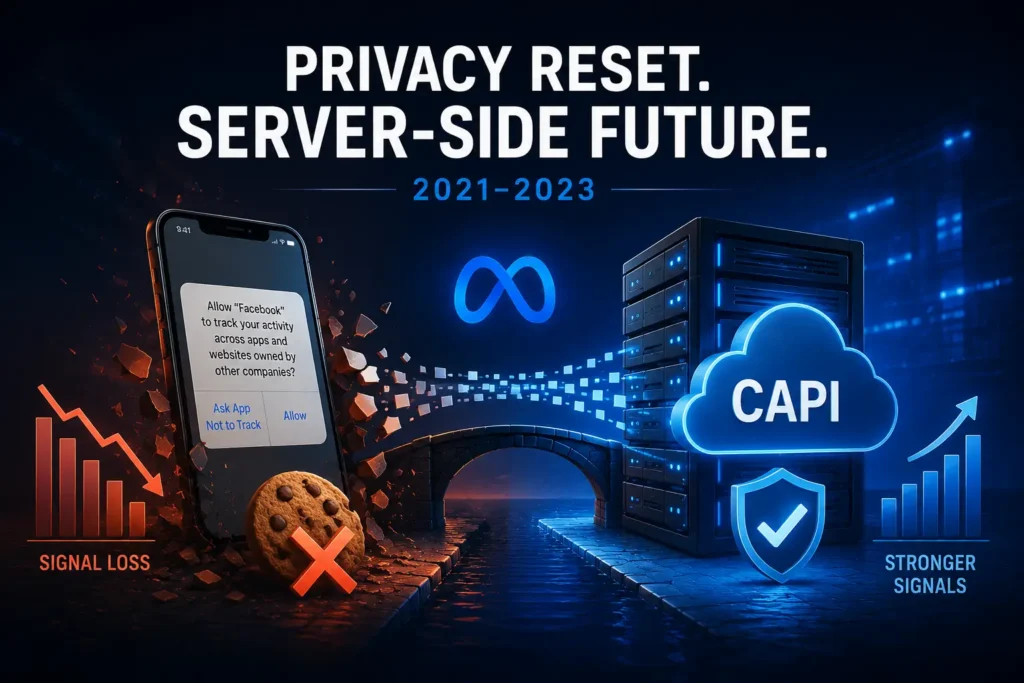
Between 2021 and 2023, the digital advertising industry faced its most disruptive structural shift. Apple’s introduction of App Tracking Transparency (ATT) in iOS 14.5 dismantled the client-side tracking architecture that platforms like Meta had relied on for over a decade.
This period forced a complete redesign of Meta’s backend infrastructure, shifting performance marketing from third-party browser cookie tracking to first-party server-side pipelines and statistical modeling.
1. The Catalyst: Apple’s App Tracking Transparency (ATT) and Signal Loss
In April 2021, Apple rolled out iOS 14.5, enforcing the App Tracking Transparency (ATT) framework. Apps were required to ask users for explicit permission to track their activity across other companies’ apps and websites via the Identifier for Advertisers (IDFA).
   ┌────────────────────────────────────────────────────────┐
   │ Allow "Facebook" to track your activity across apps     │
   │ and websites owned by other companies?                  │
   │                                                         │
   │   [ Ask App not to Track ]        [ Allow ]             │
   └─────────────────────────────────────────────────────────┘
The Immediate Consequences:
Mass Opt-Outs: Global opt-in rates dropped to approximately 15–20%, cutting off the direct data pipeline between iOS user actions and Meta’s ad delivery system.
Pixel Blindness: The traditional browser-based Meta Pixel could no longer deterministically track standard events (
AddToCart,Purchase,Lead) for opted-out users.Data Fragmentation: Without IDFA matching, custom audiences shrunk dramatically, retargeting pools collapsed, and machine-learning optimization engines lost the real-time conversion feedback required to stabilize Cost Per Acquisition (CPA).
2. The Attribution Restructure: From 28 Days to 7-Day Click / 1-Day View
Alongside signal degradation, Meta was forced to eliminate its legacy attribution model to align with data privacy limitations:
Deprecation of 28-Day Attribution: The platform retired the 28-day click-through and 7-day view-through attribution windows.
The New Default Baseline: Attribution defaulted to 7-day click and 1-day view (and often 1-day click for opted-out tracking profiles).
The ROAS Illusion: Reported Return on Ad Spend (ROAS) in Meta Ads Manager dropped overnight. While actual store revenue did not always drop by the same margin, Meta could no longer legally claim credit for sales occurring outside the contracted window, creating severe reporting discrepancies between Ads Manager and backend analytics platforms like Google Analytics or Shopify.
3. Meta’s Technical Solution: Conversions API (CAPI) & Deduplication
To restore signal fidelity, Meta shifted the tracking paradigm from the client’s browser to direct server-to-server data transmission via the Conversions API (CAPI).
Browser Event (Pixel)   ───> [ Network / Ad-Blocker Filter ] ───> Meta Servers (May Drop)
                                                                       ▲
                                                                       │ (Deduplication via Event ID)
Server Event (CAPI)     ───> [ Direct Server-to-Server POST ] ─────────┘ (100% Delivery)
How Conversions API Restores Signals:
Bypassing Browser Vulnerabilities: By routing conversion events directly from the web hosting server (or cloud containers like Google Tag Manager Server-Side) to Meta’s endpoints, tracking became immune to browser ad-blockers, iOS restrictions, and ITP (Intelligent Tracking Prevention).
Event Deduplication: Advertisers implemented dual-tracking (running both the browser Pixel and CAPI simultaneously). By sending identical
event_nameandevent_idparameters from both sources, Meta’s engine processed the first received event and discarded the duplicate, ensuring no double-counting occurred.Event Match Quality (EMQ): Server-side events transmitted customer data parameters directly through secure SHA-256 hashing. Higher volumes of matched parameters—such as hashed email (
em), hashed phone number (ph), client IP address, and browser User Agent—directly increased the EMQ score, allowing Meta to match off-platform conversions back to user accounts accurately.
4. Aggregated Event Measurement (AEM) & Conversion Modeling
To process the remaining client-side data under Apple’s Private Click Measurement constraints, Meta engineered Aggregated Event Measurement (AEM).
The 8-Event Priority Hierarchy: Domains were required to configure and rank a maximum of 8 standard conversion events per verified domain.
Highest-Priority Processing: When an opted-out iOS user completed multiple actions (e.g., viewing a product, adding to cart, and purchasing), Meta only received data for the single highest-priority event (typically
Purchase). Lower-funnel micro-events were discarded.Modeled Conversions (Probabilistic Data): To bridge the remaining attribution gap, Meta deployed statistical modeling algorithms. Instead of relying purely on deterministic tracking, the engine used aggregated historical trends, device data, and behavioral cohorts to estimate total conversion volume mathematically.
5. Strategic Adaptation: Account Consolidation & The Demise of Hyper-Segmentation
The loss of granular user-level tracking made legacy media buying strategies counterproductive. Detailed interest targeting and hyper-segmented funnels suffered from severe data starvation.
| Operational Factor | Pre-2021 Strategy (Legacy) | 2021–2023 Adaptation (Post-iOS 14.5) |
| Data Collection | Pure Browser Meta Pixel | Hybrid Setup: Pixel + Conversions API (CAPI) |
| Account Architecture | 10–30 narrow ad sets (Micro-interests) | Consolidated Structure: 2–4 broad ad sets with higher data volume per set |
| Optimization Priority | Exits learning phase via small ad set budgets | Requires 50 conversions per ad set/week; consolidation essential to exit learning |
| Attribution Window | 28-day click / 1-day view | 7-day click / 1-day view + Modeled conversions |
| Targeting Approach | Granular Lookalikes (1%, 2%) and stacked interests | Broad Targeting: Minimal demographic constraints; letting data algorithms route delivery |
The Bridge to Automation
The 2021–2023 privacy shock dismantled manual audience micro-management. By forcing advertisers to consolidate ad sets, adopt server-side tracking, and feed higher volumes of unconstrained data into the auction, it established the structural foundation required for modern artificial intelligence systems to take over campaign delivery.
Next in the Series: See how machine learning transformed these privacy fixes into fully automated media buying in Part 3: The Advantage+ and Native AI Architecture (2024–2026).