
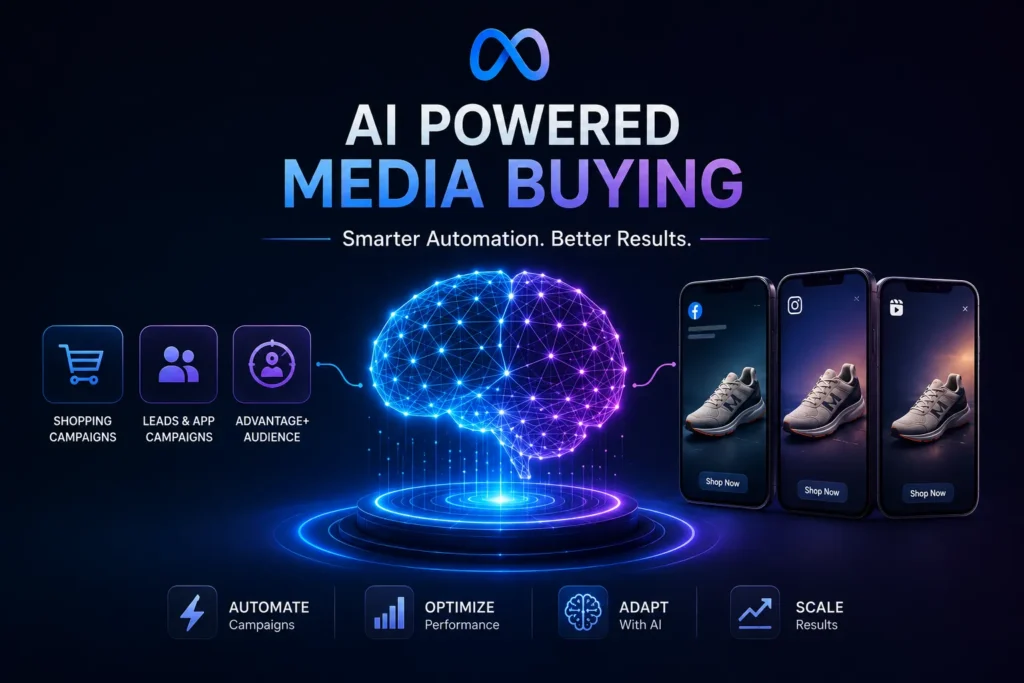
Following the post-iOS 14 data rebuild, Meta transitioned from a manual media buying platform into an autonomous, deep-learning-driven advertising engine. By 2026, campaign management no longer relies on complex audience trees or manual placement adjustments.
Instead, the platform operates on end-to-end algorithmic automation, where large-scale recommendation models and generative AI handle targeting, budget distribution, and creative delivery dynamically.
1. The Core AI Engine: Lattice and Andromeda Architectures
To handle billions of real-time ad placements with reduced deterministic data, Meta overhauled its legacy ranking infrastructure with advanced deep learning models:
Project Lattice (Next-Gen Ranking): A unified, multi-task deep learning architecture that replaced dozens of disjointed point models. Lattice simultaneously predicts multiple user actions (click-through rate, conversion propensity, post-click engagement, and long-term customer value) using a single, unified neural network.
Andromeda (Large-Scale Retrieval): An ultra-low-latency retrieval engine designed to evaluate hundreds of millions of potential ad-user combinations in milliseconds. Andromeda filters the massive pool of active global ads down to a high-intent candidate set before Lattice executes final auction pricing.
[ Active Ad Pool: Millions of Creatives ]
                    │
                    ▼  (Andromeda: High-Speed Candidate Retrieval)
[ Candidate Set: Top ~1,000 Potential Ads ]
                    │
                    ▼  (Lattice: Multi-Objective Deep Learning Ranking)
[ Optimized Ad Unit Delivered to User Feed in <50ms ]
2. The Advantage+ Suite: Total Workflow Automation
The Advantage+ ecosystem centralized campaign configuration, shifting control from human media buyers to automated platform algorithms:
Advantage+ Shopping Campaigns (ASC): An end-to-end automated framework for eCommerce. ASC consolidates prospecting, catalog retargeting, and dynamic product recommendations into a single campaign entity, optimizing daily spend automatically across Facebook, Instagram, Reels, and Audience Network.
Advantage+ Leads & App Campaigns: Performance-driven frameworks that dynamically cycle through instant forms, landing pages, and app-install paths based on an individual user’s conversion probability.
Advantage+ Audience (Algorithmic Targeting): Replaces rigid interest and demographic boundaries. While advertisers can still supply audience “suggestions” (such as customer lists or broad interests), the AI treats them purely as loose hints, expanding automatically beyond predefined limits whenever cheaper, high-intent conversion opportunities exist.
3. Generative AI Tools & Dynamic Creative Assembly
Modern ad delivery modifies creative elements in real time based on user consumption habits, leveraging native generative AI directly inside Meta Ads Manager:
Static Base Image / Video Asset
                    │
   ┌────────────────┼────────────────┬────────────────┐
   ▼                ▼                ▼                ▼
[ Dynamic Aspect  [ Text Generation [ AI Background  [ Visual Quality
  Ratio Expansion ] Variations ]      Swapping ]       Enhancements ]
   (9:16 / 1:1 / 16:9) (Headlines/Copy) (Contextual)   (Brightness/Contrast)
Key Capabilities:
Image & Video Expansion: Auto-generates matching pixel textures to expand 1:1 assets seamlessly into 9:16 vertical full-screen formats for Reels and Stories.
Contextual Background Generation: Dynamically swaps product backgrounds to match seasonal trends, regional settings, or individual aesthetic preferences.
Automated Copy Tuning: Analyzes the landing page destination and historical user response patterns to generate optimized primary text, headlines, and calls-to-action per impression.
4. The Modern Paradigm: Creative as Targeting
In an ecosystem where broad targeting is standard and manual interest segmentation is obsolete, the creative itself has become the primary targeting lever.
Creative Filtering: The algorithm analyzes the first three seconds of a video (the hook), on-screen text overlays, and transcript audio to determine audience intent. An ad highlighting “B2B SaaS churn reduction” automatically triggers the algorithm to find enterprise decision-makers without manual B2B targeting.
Diversification Strategy: Running 10 minor text tweaks of the same image creates internal auction overlap. High-performing accounts now run distinct creative angles (e.g., Founder Story, Social Proof/Reviews, Direct Product Demo, Pain-Point Callout) to unlock completely different segments of the total addressable market.
5. Architectural Comparison: 2016 vs. 2026
| Dimension | Legacy Era (2016) | Autonomous AI Era (2026) |
| Campaign Topology | 20–50 Ad Sets per campaign | 1–3 Consolidated Campaigns (Advantage+ native) |
| Audience Strategy | 1% Lookalikes, narrow interest stacks | Advantage+ Audience / Broad (Creative acts as filter) |
| Asset Optimization | Static, single-dimension creative assets | Dynamic Generative AI (Auto-expanded ratios, copy tuning) |
| Primary Media Buyer Role | Technical bidding, bid-cap adjustments, audience hacking | Creative strategist, offer architect, and first-party data manager |
| Data Engine | Browser client cookies (Pixel) | Conversions API (CAPI) + Lattice deep learning modeling |
The Evolution Completed
From the manual, cookie-dependent interest hacking of 2007–2020 through the privacy-driven server-side transition of 2021–2023, Meta Ads has evolved into a fully automated recommendation system. Long-term performance in 2026 relies on feeding clean first-party conversion data into CAPI while systematically producing diverse, high-converting creative assets that guide the algorithm to the right customers.
Series Overview: Catch up on the history behind this AI transformation: