
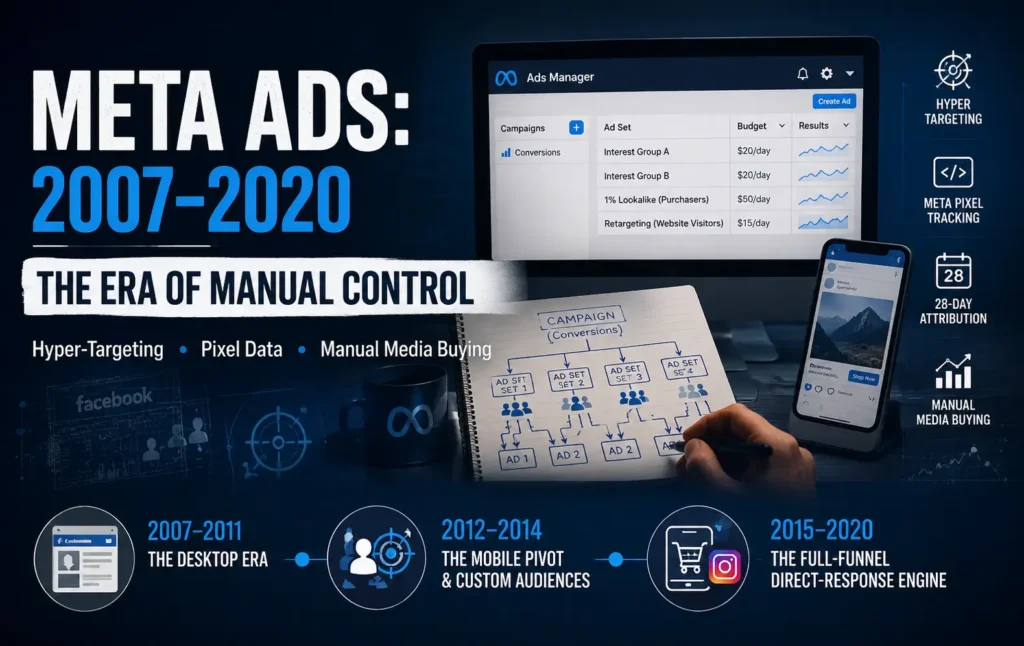
Between 2007 and 2020, Meta (formerly Facebook) transformed digital advertising from static sidebar banners into the most sophisticated direct-response advertising engine in the world. This era was defined by deterministic user tracking, granular audience segmentation, and manual media buying tactics where advertisers controlled every dollar at the ad set level.
Understanding the mechanics, attribution frameworks, and operational strategies of this era provides the essential context for why modern ad algorithms function the way they do today.
1. The Architectural Evolution: From “Flyers” to Mobile Native Placements
The platform’s ad infrastructure evolved through three distinct phases during this period:
2007–2011 (The Desktop Era): Advertising was initiated via Facebook Flyers and basic sidebar display units. Targeting was limited to rudimentary demographic data (age, gender, college networks, and declared profile interests).
2012–2014 (The Mobile Pivot & Custom Audiences): Following its IPO, Facebook shifted entirely to in-feed mobile advertising. During this phase, Facebook introduced Custom Audiences (matching hashed customer email and phone lists via SHA-256) and Lookalike Audiences (algorithmic modeling to find users statistically similar to a source list).
2015–2020 (The Full-Funnel Direct-Response Engine): The launch of the Instagram ad placement, Dynamic Product Ads (DPA) for eCommerce catalogs, and Instagram Stories ads turned the platform into a dominant direct-response channel for performance marketers globally.
2. The Tracking Backbone: The Unified Meta Pixel & 28-Day Attribution
The unprecedented performance of Meta Ads in this era was anchored by client-side browser tracking and a wide attribution window:
The Browser-Based Meta Pixel
Deployed via a JavaScript snippet in the website header, the Pixel logged standard events (PageView, ViewContent, AddToCart, InitiateCheckout, Purchase, Lead). It cross-referenced browser cookies with active Facebook user sessions with near-perfect deterministic accuracy, unrestricted by third-party cookie blocks or operating system level tracking prompts.
The 28-Day Attribution Model
The standard default attribution setting was 28-day click, 1-day view. If a user clicked an ad and converted anytime within the subsequent four weeks, Meta claimed 100% of the conversion value. This generous attribution window offered two distinct advantages:
It fed vast volumes of deterministic data back into the machine-learning feedback loop.
It generated exceptionally high Return on Ad Spend (ROAS) figures in Ads Manager reports.
3. The Classic Media Buying Playbook: Manual Segmentation & ABO
During this phase, the algorithm required humans to manually dictate who saw what ad, at what frequency, and with what budget allocation.
Campaign (Objective: Conversions)
│
├── Ad Set 1: Interest Group A (ABO: $20/day) ──> Ad Creative 1, 2
├── Ad Set 2: Interest Group B (ABO: $20/day) ──> Ad Creative 1, 2
├── Ad Set 3: 1% Lookalike (Purchasers) ($50/day) ──> Ad Creative 1, 2
└── Ad Set 4: Retargeting (30-Day Website Visitors) ($15/day) ──> Offer Ad
Key Strategies of the Era:
Ad Set Budget Optimization (ABO): Media buyers manually allocated specific daily budgets to individual ad sets to strictly control spend distribution.
Interest Layering & “Laser” Targeting: Advertisers built complex Boolean logic chains (e.g., Target: Interests in Shopify AND Engaged Shoppers, EXCLUDING Drop Shipping).
Segmented Lookalike Stacks: Marketers created partitioned Lookalikes (1%, 1–2%, 2–5%, and 5–10%) to isolate the highest-performing affinity tiers.
Hard-Coded Funnel Isolation: Accounts were strictly divided into Top-of-Funnel (Cold/Interests), Middle-of-Funnel (Engagers/Video Viewers), and Bottom-of-Funnel (Pixel Website Visitors/Cart Abandoners), with strict negative audience exclusions applied at every step to avoid overlap.
4. Early Auction Mechanics: The Total Value Equation
Meta’s ad delivery system balanced advertiser value with user experience through an auction-based pricing model executed in milliseconds:
Advertiser Bid: The monetary amount an advertiser was willing to pay for a specific action (e.g., Max Bid or Lowest Cost).
Estimated Action Rate ($eCTR$, $eCVR$): The algorithm’s real-time prediction of how likely a given user was to click and complete the optimization event.
User Value (Ad Quality & Relevance): A composite score measuring historical creative engagement, positive interactions, post-click landing page speed, and negative feedback (e.g., users clicking “Hide Ad”).
Because detailed interest targeting kept audiences small, media buyers frequently adjusted bids manually to compete inside narrow, hyper-competitive auctions.
5. Summary of the Era: Strengths vs. Structural Vulnerabilities
| Operational Pillar | Early Era Reality (2007–2020) | Inherent Limitation / Vulnerability |
| Audience Strategy | Micro-segmented interest groups and 1% Lookalikes | Audience Saturation: Small pools caused frequency to spike rapidly, causing ad fatigue. |
| Budget Management | Manual Ad Set Budget Optimization (ABO) | Operational Inefficiency: Required constant manual budget shifts across 20–50 ad sets daily. |
| Internal Auction Dynamic | Running multiple identical audiences in different ad sets | Auction Overlap: Advertisers frequently bid against their own ad sets, artificially driving up CPMs. |
| Tracking Infrastructure | 3rd-party browser pixel cookies | Single Point of Failure: 100% reliant on client-side tracking without server-side verification. |
Why the Paradigm Ended
By late 2020, this manual operational model reached its natural limits. Audience micro-segmentation caused severe auction overlap, and high maintenance costs limited scalability for growing brands.
More critically, the industry’s total reliance on browser-level cookie tracking left advertisers completely unprotected against the major platform privacy changes that would arrive in 2021.
Next in the Series: Understand how Apple’s privacy updates broke this manual framework in Part 2: The Privacy Reset & Server-Side Tracking Era (2021–2023).