
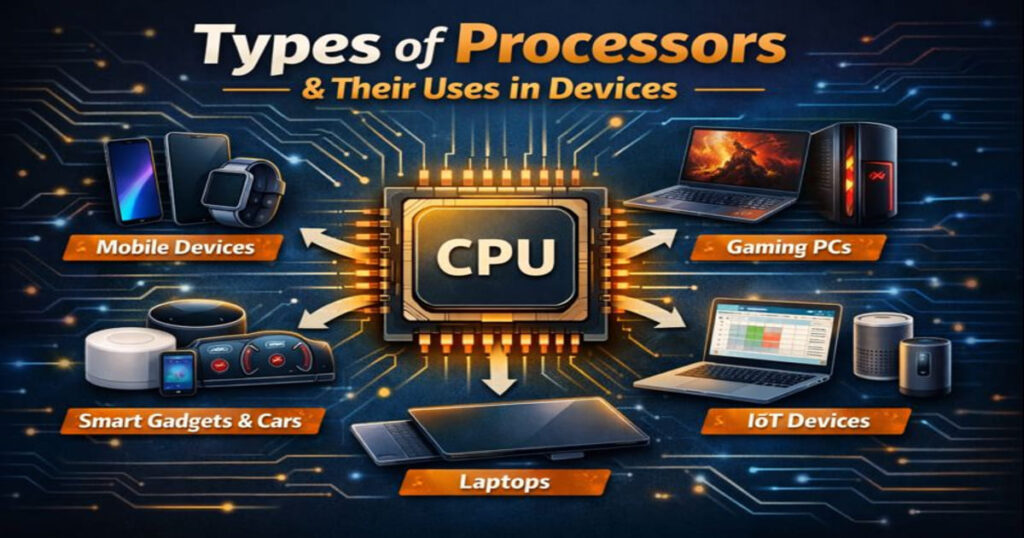
Every digital device we use today depends on one small but powerful component. — the processor. Whether it’s a smartphone, laptop, smart TV, or even a smartwatch, the types of processors acts as the brain that controls everything happening inside the device.
When a device feels fast and smooth, the processor is usually doing its job well. When it feels slow or laggy, the processor often becomes the limiting factors take these steps to make you smartphone performance better.
From my experience working with different gadgets over the years — upgrading phones, testing laptops, helping friends choose devices — I’ve noticed something interesting. Most people focus only on RAM, storage, or camera features, but they rarely understand the importance of the processor. In reality, the processor decides how responsive, efficient, and future-proof your device will be.
In this guide, we’ll break down the main types of processors and explain where each one is used. No complicated technical language. Just simple explanations and real-world examples to help you understand how processors affect everyday performance.
What Is a Processor in Simple Words?
A processor, also called a CPU (Central Processing Unit), is the part of a device that performs calculations and executes instructions.
In simple terms:
- It opens apps
- Runs software
- Handles multitasking
- Processes data
- Controls overall speed
- It opens apps
This works like the brain of your device. The better the brain, the smoother everything feels.
Why Processors Matter More Than Specs on Paper
Many buyers compare only RAM or storage numbers. But from practical experience, a good processor often matters more than both.
For example:
- A strong processor with 6GB RAM → smooth performance
- A weak processor with 8GB RAM → still laggy
- A strong processor with 6GB RAM → smooth performance
This happens because the processor handles the actual workload.
That’s why understanding of the types of processors helps you choose smarter devices.
Popular Processor Brands and Families You Should Know
Along with understanding types of processors, it is also helpful to recognize the processor families commonly used in real devices. These names often appear in product specifications, and knowing what they mean can make your buying decision much easier.
Some well-known processor families include:
- Qualcomm Snapdragon – Frequently used in Android smartphones and known for smooth performance, good battery optimization, and stable gaming
- MediaTek Dimensity – Common in budget and mid-range phones, offering reliable everyday performance at affordable prices
- Apple Bionic and M Series – Designed specifically for Apple devices, focused on fast processing and excellent power efficiency
- Intel Core (i3, i5, i7, i9) – Popular in laptops and desktops for office work, multitasking, and professional software
- AMD Ryzen – Widely appreciated for strong multi-core performance, gaming, and creative tasks
- ARM-based processors – Used in smart TVs, routers, wearables, and IoT devices because they consume very little power
- Qualcomm Snapdragon – Frequently used in Android smartphones and known for smooth performance, good battery optimization, and stable gaming
Understanding these names helps you compare devices more confidently instead of relying only on marketing claims.
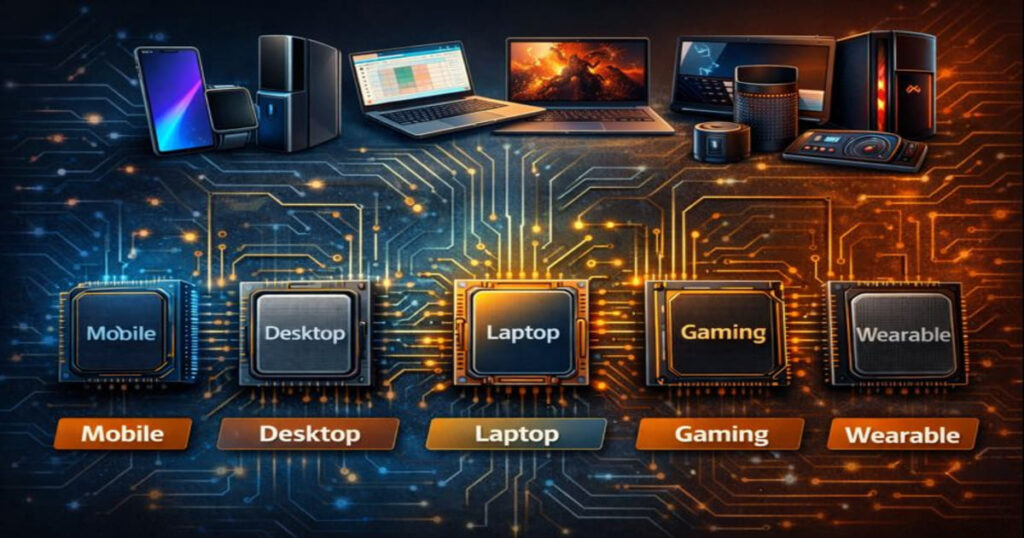
Main Types of Processors and Their Uses
Let’s look at different processor categories used in everyday devices.
Mobile Processors (Smartphones & Tablets)
These processors are designed for:
- Low power usage
- Less heat
- Long battery life
- Balanced performance
- Low power usage
Where they are used:
- Smartphones
- Tablets
- Budget laptops
- Portable gadgets
- Smartphones
Key benefits:
- Energy efficient
- Smooth daily tasks
- Good multitasking
- Better battery life
- Energy efficient
Real-life experience:
When I compare phones for friends, the biggest difference in speed usually comes from the processor generation, not the camera or RAM. A newer mobile processor feels faster even with similar specs for a new Purchase of mobile.
Desktop Processors (PC CPUs)
Desktop processors focus more on performance than power saving.
They are built for:
- Heavy workloads
- High speed
- Long usage sessions
- Gaming and editing
- Heavy workloads
Where they are used:
- Desktop computers
- Gaming PCs
- Workstations
- Office systems
- Desktop computers
Key benefits:
- High performance
- Supports heavy software
- Better cooling
- Ideal for professionals
- High performance
Experience insight:
For video editing or multitasking work, desktops with strong processors perform much better than laptops. Tasks finish faster and systems stay stable.
Laptop Processors
Laptop processors are a balance between mobile and desktop CPUs.
They aim for:
- Decent performance
- Moderate power usage
- Heat control
- Decent performance
Too much power → battery drains fast
Too little → slow laptop
Where they are used:
- Notebooks
- Ultrabooks
- Student laptops
- Business laptops
- Notebooks
So they are optimized carefully.
Key benefits:
- Balanced speed
- Good battery life
- Portable performance
- Balanced speed
Great for students and office users.
Real-world note:
In daily use, laptops with efficient processors last longer on battery and stay cooler. Cheap high-power processors sometimes overheat and throttle performance.
Gaming Processors
Gaming processors focus on:
- High clock speeds
- Multiple cores
- Fast data handling
- High clock speeds
Modern games require both CPU and GPU performance.
Where they are used:
- Gaming PCs
- Gaming laptops
- Consoles
- High-performance systems
- Gaming PCs
Key benefits:
- Fast response time
- Better multitasking
- Smooth gaming
- Fast response time
Ideal for gamers and creators.
Experience:
While testing games, I’ve seen that weak processors cause stuttering even when graphics settings are low. A strong mobile gaming processor and laptop processor give smoother gameplay and stable frame rates.
Embedded Processors
These processors are small and specialized. They are not meant for general use but for specific tasks.
They focus on:
- Stability
- Low power
- Simple operations
Where they are used:
- Smart TVs
- Washing machines
- Cars
- Routers
- IoT devices
- Home appliances
- Smart TVs
Key benefits:
- Reliable
- Low energy consumption
- Cost-effective
- Reliable
Perfect for dedicated functions.
Example:
Your smart TV has a processor that handles apps and streaming, but it doesn’t need heavy computing power like a PC.
Wearable Processors
Wearables need extremely low power usage.
These processors are designed for:
- Small size
- Minimal heat
- Long battery life
- Small size
Where they are used:
- Smartwatches
- Fitness bands
- Health trackers
- Smartwatches
Key benefits:
- Ultra efficient
- Compact
- Lightweight
- Ultra efficient
Experience:
Devices with optimized processors easily last days on a single charge, while poorly optimized ones drain quickly.
Choosing the Right Processor for Your Needs
Instead of chasing technical terms, focus on usage.
For basic users:
Browsing, calls, apps → mobile/laptop processors
For students:
Assignments, browsing, light editing → mid-range laptop CPU
For gamers:
High-performance desktop/gaming processors
For professionals:
Editing, coding, design → powerful desktop CPUs
For smart devices:
Embedded processors are enough
Choosing the Right Processor for Your Needs
Instead of chasing technical terms, focus on usage.
| Processor Type | Common Devices | Best For |
|---|---|---|
| Mobile Processors | Smartphones | Daily apps, browsing, social media |
| Mid/High-End Mobile Chips | Premium phones | Gaming, multitasking, heavy apps |
| Laptop Processors | Laptops | Office work, study, productivity |
| Desktop CPUs | PCs | Editing, development, professional software |
| Gaming Processors | Gaming PCs/phones | High performance and graphics-heavy tasks |
| Embedded/ARM Chips | Routers, TVs, IoT devices | Low power and background processing |
| Wearable Chips | Smartwatches/bands | Sensors and long battery life |
This quick overview gives beginners a practical understanding of where each processor fits in real life.
Real-World Experience Tips Before Choosing a Processor
In day-to-day usage, many people assume that the highest number automatically means the best types of processors. However, from practical experience, choosing based on actual needs usually delivers better results than simply going for the most powerful option.
Here are some simple observations from real-world use:
- For calls, messaging, browsing, and social media → a mid-range mobile processor works perfectly fine.
- For gaming or heavy multitasking → higher-end chips provide smoother performance for both.
- Intel i5 or Ryzen 5 processors deliver speed and stability for study and office tasks.
- For video editing, gaming, design, or professional software → i7, Ryzen 7, or Apple M-series processors handle workloads better laptop.
- For routers, smart devices, or wearables → energy-efficient ARM chips are ideal.
In most cases, balanced performance, good cooling, and battery efficiency matter more than raw speed. A well-optimized device often feels faster than one with an unnecessarily powerful processor.
Common Myths About Processors
Myth 1: More cores always mean faster
- Not always. Optimization also matters.
Myth 2: Higher numbers guarantee better speed
- Generation and efficiency matter more.
Myth 3: All processors feel the same
- Real-world performance varies a lot.
From experience, newer architecture often beats older high-spec processors.
Practical Tips From Experience
Over the years, I’ve learned:
- Always choose newer generation processors
- Avoid very old chipsets
- Balance power + efficiency
- Read real-world reviews, not just specs
- Don’t overspend for unused power
- Always choose newer generation processors
These small decisions make devices last longer and feel smoother.
FAQs
1. Which processor is best for everyday use?
Mobile or mid-range laptop processors are enough for daily tasks like browsing, streaming, and apps.
2. Do more cores improve performance?
They help multitasking, but overall optimization matters more.
3. Is a gaming processor necessary for normal users?
No. It’s only useful if you play heavy games or do professional work.
4. Why do some devices heat up quickly?
Low-efficiency processors consume more power and run hotter.
5. How long does a good processor last?
With proper usage, most devices run smoothly for 3–5 years.
Conclusion
Processors may be small components, but they have the biggest impact on how a device performs. From smartphones to desktops, every device depends on the processor to deliver speed, efficiency, and stability.
Based on personal experience using different gadgets, the right processor can make a device feel smooth for years, while the wrong one can cause frustration within months.
Instead of chasing numbers or marketing terms, focus on your needs and choose wisely. A well-balanced processor always gives better real-life performance than flashy specifications.
Understanding processors helps you make smarter buying decisions — and saves both money and time in the long run.




Pingback: Mobile Processors Used in Smartphones Available in India
Pingback: High-Demand Laptop Processor in India
Pingback: How to Choose the Best Budget Laptop in 2026