

Buying a budget smartphone today is surprisingly complicated. A few years ago, budget meant basic — average camera, slow processor, limited storage. Now, even under ₹15,000–₹20,000, you’ll see 120Hz displays, 5G support, 50MP cameras, and processors like Snapdragon 7s Gen 2 or Dimensity 7050.
The problem is not shortage of options. The problem is clarity.
Most buyers either:
- Choose based on brand name
- Focus only on megapixels
- Or buy whatever is trending online
A better approach is simple: match the phone to your actual usage. This guide will walk you through that process logically and realistically, without hype or exaggerated claims.
Disclaimer: Smartphone specifications, pricing, and software update policies change frequently.
What Do You Actually Use Your Phone For?
Before comparing specifications, pause for a moment.
Do you mostly use:
- WhatsApp, YouTube, and social media?
- BGMI or Call of Duty Mobile?
- Camera for Instagram or travel photos?
- Long battery for all-day usage?
- Or do you simply want a reliable phone for 3–4 years?
Your primary usage should decide your priority — not marketing terms.
To make this clearer, here’s a quick reference table.
What’s Best for Whom?
| User Type | What Matters Most | Suitable Processor Level |
|---|---|---|
| Basic User (Calls, YouTube, WhatsApp) | Battery + Stability | Snapdragon 4 Gen 1 / Dimensity 6020 |
| Student | Balanced performance + 128GB storage | Snapdragon 6 Gen 1 / Dimensity 6100+ |
| Casual Gamer | Stable performance + Good GPU | Snapdragon 7s Gen 2 / Dimensity 7050 |
| Heavy Gamer | Strong GPU + Cooling | Snapdragon 7+ Gen 2 |
| Camera-Focused User | Good ISP + Sensor optimization | Snapdragon 7s Gen 2 / Dimensity 7050 |
| Long-Term User (3+ years) | Software updates + 8GB RAM | Snapdragon 6 or 7 series |
This table is not about brands — it’s about matching performance level with usage expectations.
Processor: The Real Backbone of a Smartphone
The processor (SoC) controls performance, camera processing, battery efficiency, and gaming stability. In the budget and upper-budget category, these processors are commonly seen:
Processor Comparison Overview
| Processor | Process Node | Ideal For |
|---|---|---|
| Snapdragon 4 Gen 1 | 6nm | Basic daily tasks |
| Snapdragon 6 Gen 1 | 4nm | Smooth multitasking |
| Snapdragon 7s Gen 2 | 4nm | Gaming + performance balance |
| Snapdragon 7+ Gen 2 | 4nm | Heavy gaming |
| Dimensity 6020 | 7nm | Entry 5G usage |
| Dimensity 6100+ | 6nm | Budget multitasking |
| Dimensity 7050 | 6nm | Upper-budget performance |
Smaller process nodes (like 4nm) generally mean better power efficiency.
If you plan to use your device for more than two years, avoid very entry-level processors. A slightly stronger chipset now can prevent lag later.
RAM and Storage: Future-Proofing Matters
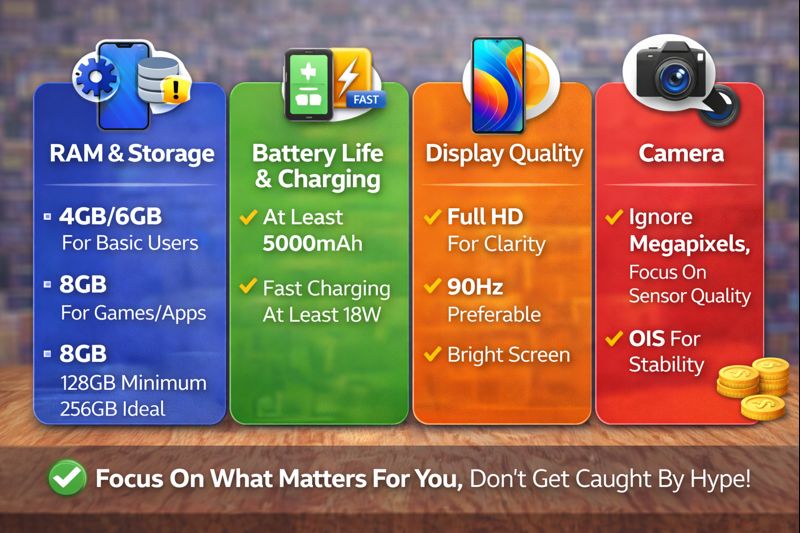
In 2026, 4GB RAM is only suitable for very light users. Apps are heavier than before, and background processes consume more memory.
Recommended minimum today:
- 6GB RAM (8GB preferred for long-term use)
- 128GB storage
Storage type also affects speed:
Storage Type | Performance Impact |
UFS 2.2 | Faster app loading and file transfers |
eMMC | Noticeably slower |
Many buyers ignore storage type, but UFS makes daily performance feel smoother.
Battery and Charging: More Than Just mAh
Battery capacity alone does not guarantee longer backup. Efficiency depends on both battery size and processor optimization.
Battery Capacity | Suitable For |
5000mAh | Standard daily use |
6000mAh | Heavy users |
Charging speeds typically range between:
- 18W (basic)
- 33W (balanced)
- 67W (fast)
If you travel frequently or stay outdoors long hours, battery reliability is more important than fast charging.
Software Experience and Updates
Long-term satisfaction often depends more on software than hardware.
Before buying, check:
- Android version at launch
- Number of promised updates
- Security patch frequency
Some brands provide cleaner interfaces, while others offer more customization but may include extra apps. A clean UI often feels smoother even with similar hardware.
If you plan to use your phone for 3–4 years, software support becomes very important.
Is 5G Necessary?
If you are buying a phone for long-term use, choosing a 5G-supported processor makes practical sense.
However, do not compromise on:
- RAM
- Processor quality
- Storage type
Performance matters more than the number of 5G bands listed on the box.
Common Buying Mistakes
Many buyers regret their decision because they:
- Choose the cheapest 5G phone without checking processor power
- Buy 4GB RAM thinking it’s “enough”
- Focus only on megapixels
- Ignore storage type
- Overlook software update policy
A slightly balanced device often delivers better long-term value than a spec-heavy phone with weak fundamentals.
A Practical Buying Framework
Instead of comparing ten models randomly, follow this process:
- Define your usage.
- Select processor category accordingly.
- Ensure minimum 6GB RAM and 128GB storage.
- Check display type and refresh rate.
- Evaluate battery and charging needs.
- Verify software support.
- Compare 2–3 shortlisted devices only.
This reduces confusion and prevents impulse decisions.
Build Quality and Comfort
Budget doesn’t mean cheap feeling. You use your phone all day. It should feel comfortable.
Check:
- weight
- grip
- button placement
- fingerprint position
A phone that feels good in hand is more enjoyable to use daily. Sometimes small design details matter more than extra features.
Network and Connectivity Features
Make sure your phone supports:
- latest network standards
- good WiFi support
- Bluetooth stability
Better connectivity ensures:
- faster downloads
- stable calls
- smooth streaming
In real usage, stable connection improves overall experience more than small spec upgrades.
Don’t Buy Only Based on Brand Hype
Big brands don’t always mean best value.
And smaller brands don’t always mean bad quality.
Instead:
- compare features
- read reviews
- focus on value
From helping many buyers, I’ve seen that sometimes lesser-known models offer better performance for the same price. Always compare calmly before buying.
FAQs
Is more RAM always better?
- Not always. Processor quality matters more.
Should I buy 5G in budget smartphone?
- If available at similar price, yes. It’s more future-ready.
How long should a budget smartphone last?
- With good care and updates, 3–4 years easily.
Final Thoughts
Choosing the right budget smartphone is not about chasing trends or marketing labels. It’s about understanding what you need and selecting hardware that supports it.
A well-balanced device with:
- A capable processor
- Adequate RAM
- Reliable battery
- Clean software
…will always feel better in daily use than a spec-heavy device with weak fundamentals.
If you approach your purchase logically instead of emotionally, even a budget smartphone can offer a smooth, reliable experience for years.
The right choice is not the most advertised one — it’s the one that fits your usage best.




Pingback: Types of Processors and Their Uses in Devices
Pingback: Mobile Processors Used in Smartphones Available in India