
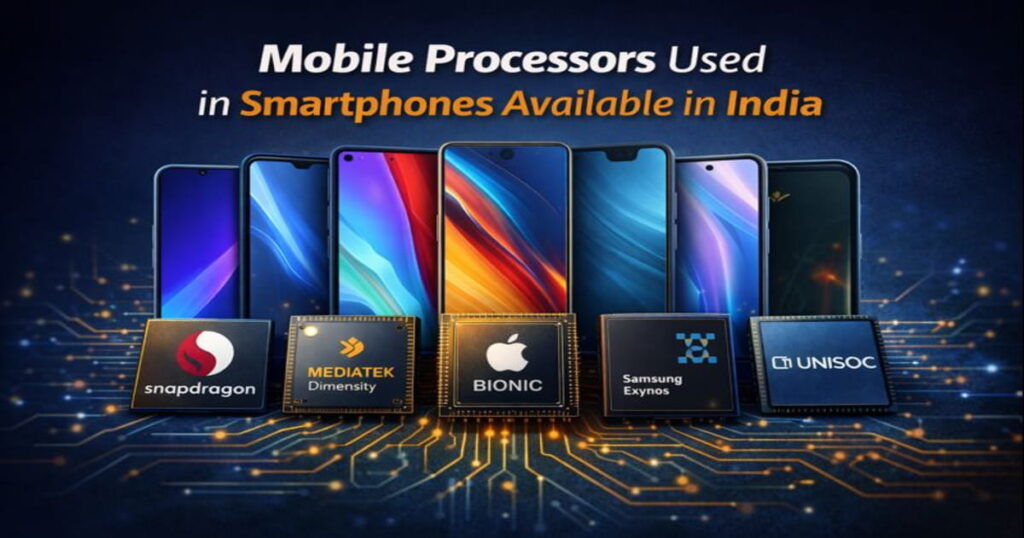
Choosing the right smartphone with right mobile processors can feel overwhelming, especially in 2026, when the Indian market is flooded with hundreds of models, each claiming to be the fastest or most efficient. While many buyers focus on camera specs, battery size, or RAM, one component often makes the biggest difference in day-to-day performance: the processor.
From my experience testing phones, helping friends and family pick devices, and observing performance in real-life scenarios, I’ve realized that understanding processors is key to buying a phone that feels smooth and reliable for years.
This guide will break down the popular mobile processors used in India, their strengths, and practical advice to help you pick the right smartphone for your needs.
What is a Mobile Processors?
A mobile processor, also called a SoC (System on Chip), is the brain of your smartphone. It handles all calculations, runs apps, manages battery efficiency, and controls graphics performance.
In simple words:
- Processor speed affects how fast apps open
- It controls multitasking efficiency
- Determines gaming and video playback performance
- Affects battery usage and heating
Even a phone with large RAM or fancy cameras can feel slow if it has a weak processor.
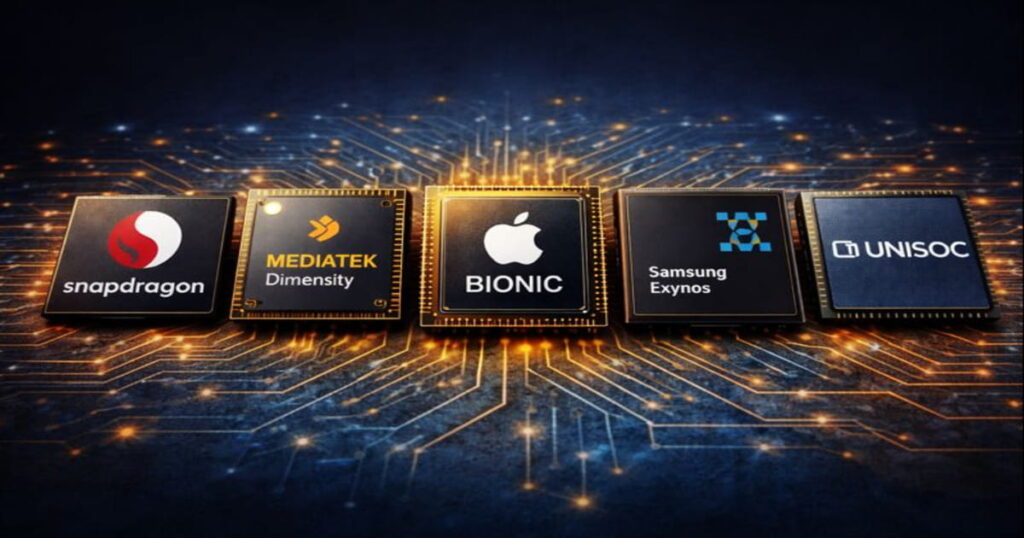
Popular Mobile Processors Available in India
Here’s a breakdown of processors you’ll commonly see in 2026 smartphones in India, along with practical experience notes.
Qualcomm Snapdragon Series
- Where used: Most Android smartphones across premium, mid-range, and some budget smartphone’s models
- Why popular: Offers smooth performance, energy efficiency, and reliable gaming experience
Examples: Snapdragon 4/6/7/8 Gen series
Experience Tip:
A Snapdragon 7 series phone often handles daily apps and light gaming effortlessly. Snapdragon 8 Gen series feels nearly flagship-level smooth, even with heavy multitasking or graphics-intensive games.
MediaTek Dimensity Series
- Where used: Budget and mid-range phones from brands like Realme, Xiaomi, and iQOO
- Why popular: Offers strong value for money, decent gaming performance, and efficient battery management
- Examples: Dimensity 6100, 8100, 9000 series
Experience Tip:
Phones with Dimensity 8100/9000 can handle PUBG or COD Mobile on high settings with minimal lag. For casual users, lower-end Dimensity chips provide more than enough speed.
Apple A/Bionic Series
- Where used: iPhones (e.g., A16 Bionic in iPhone 14 series, M2 chip in iPad)
- Why popular: Optimized for iOS, provides unmatched performance, excellent efficiency, and long-term software support
Experience Tip:
Even older iPhones feel fast because Apple tightly integrates hardware and software. Battery life is optimized without needing huge battery capacity.
Samsung Exynos Series
- Where used: Samsung smartphones, mainly Galaxy series sold in India
- Why popular: Reliable for mid-range and flagship devices, energy-efficient
- Experience Tip:
Exynos chips perform well in daily use, though for gaming, Snapdragon variants slightly outperform them in frame rate consistency.
Unisoc Processors
- Where used: Entry-level phones, often for first-time smartphone users
- Why popular: Cost-effective, basic performance, low energy usage
Experience Tip: These are fine for WhatsApp, YouTube, and calling, but heavy apps or multitasking can be slow. Ideal for parents or elderly users.
How to Choose the Right Mobile Processor in India
Buying a smartphone isn’t just about raw power. Consider your real-world usage:
- Basic use (calls, WhatsApp, social media): Snapdragon 4 series or Dimensity 600/700 series
- Mid-range use (gaming, multitasking, content consumption): Snapdragon 7 series, Dimensity 800/900 series
- High-end use (heavy gaming, editing, flagship experience): Snapdragon 8 series, Apple A/Bionic series
- Budget-friendly and basic users: Unisoc or lower-end MediaTek processors
Experience Tip: I’ve noticed that users who buy phones for “future-proofing” often overspend. A mid-range processor today handles everything most users need for 2–3 years without issues.
Common Myths About Mobile Processors
Myth 1: More cores = faster phone
Not necessarily. Optimization and architecture matter more than just the number of cores.
Myth 2: High RAM makes a phone fast
RAM helps, but a weak processor bottlenecks performance. Always check both.
Myth 3: Battery drains faster with powerful processors
Modern chips are energy-efficient. High-end processors often manage battery better under heavy use.
Real-World Experience-Based Tips
- Check reviews for your region: Many Mobile processors perform differently under India’s climate, especially heat.
- Don’t rely solely on benchmarks: They measure raw power but not real-world smoothness.
- Consider software optimization: Even a good processor feels slow if the manufacturer’s software is heavy or full of bloatware.
- Future-proofing: Choose processors that will support OS updates for at least 2–3 years.
FAQs
Q1: Which mobile processor is best for gaming in India?
A: Snapdragon 8 series or Dimensity 9000+ are excellent choices for smooth gaming.
Q2: Is Apple Bionic series better than Snapdragon?
A: For iOS devices, yes, because Apple optimizes both hardware and software perfectly. For Android, Snapdragon 8 series is flagship-level.
Q3: Are MediaTek Dimensity processors good?
A: Yes, especially for budget and mid-range phones. High-end Dimensity chips perform almost as well as Snapdragon 8 series in real use.
Q4: Should I always go for the latest processor?
A: Not necessary. Mid-range or last-generation flagship processors often provide excellent performance at lower prices.
Q5: Do entry-level Unisoc processors work for WhatsApp and YouTube?
A: Absolutely. They are ideal for basic use but not for gaming or heavy apps.
Conclusion
Understanding mobile processors in India can save you time, money, and frustration. The processor you choose determines your phone’s performance, battery efficiency, gaming ability, and longevity.
From personal experience, mid-range chips like Snapdragon 7 series or Dimensity 800/900 series often provide the best balance between price and performance for most users. For iPhone buyers, Apple’s Bionic series remains unmatched in daily experience. Meanwhile, entry-level processors like Unisoc are perfect for casual users or those prioritizing affordability.
Focus on your real needs, check reviews, and don’t get swayed by marketing claims. A well-chosen processor ensures your smartphone stays smooth and reliable for years.




Pingback: Types of Processors and Their Uses in Devices
Pingback: How to Choose the Right Budget Smartphone in 2026
Pingback: How to Make Your Android Phone Faster in Minutes